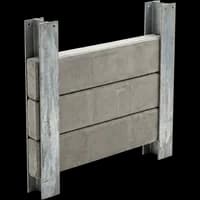
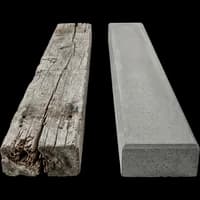
Concrete Sleeper
 Concrete Block
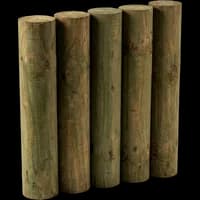
 Timber Sleeper
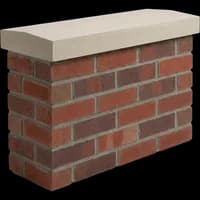
 Brick
Brick Palisade
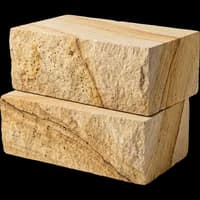
 Sandstone
 Repairs & Replacement
 What A Wall Costs
 Rules, Approvals & Engineering
 Treated Pine
Green Treated Pine
The standard H4 treated pine sleeper. It starts pale green and weathers to silver-grey.
A timber retaining wall in Canberra is treated pine or hardwood in steel or timber posts. Usually the cheapest to build, and the one most often rebuilt because the first one had no drainage.
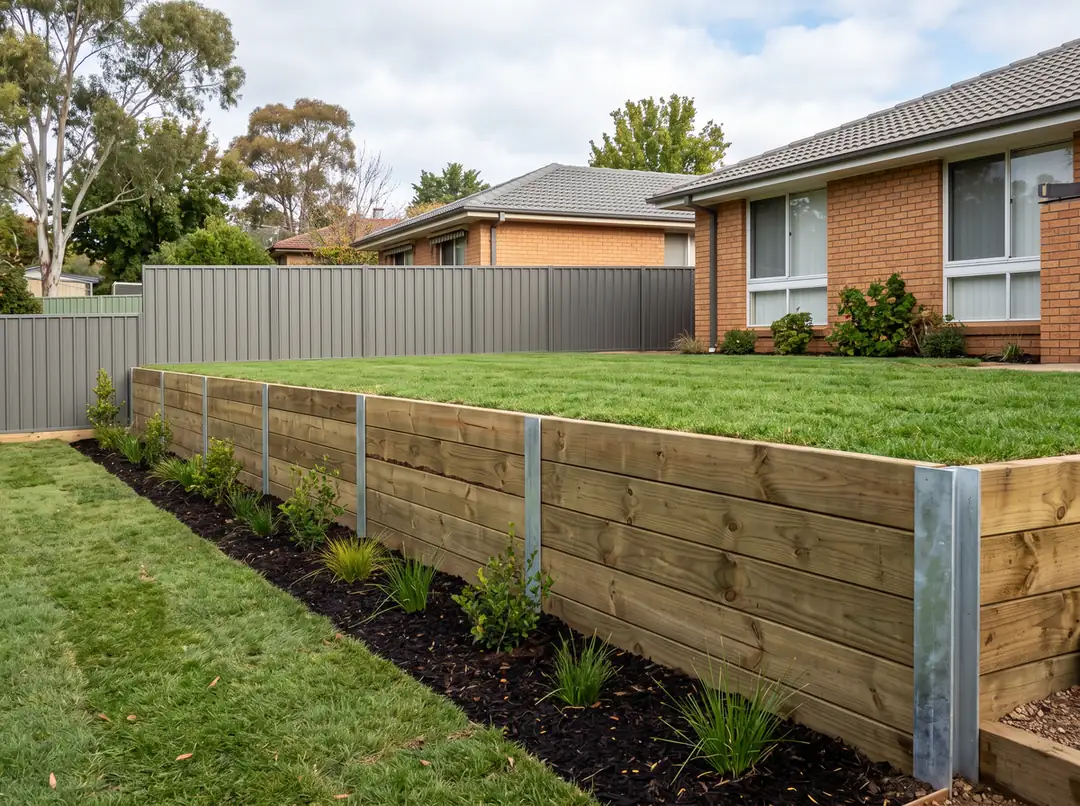
Timber retaining wall sleepers are laid horizontally between posts set in concrete to hold back the soil. This is usually the cheapest wall to build, and it suits garden beds, low terraces and long runs under about a metre. For a tall boundary wall, or a wall you want to build once, concrete sleepers are the better buy.
Raised beds, terraces and edges up to about a metre, where the wall holds a garden rather than a driveway.
When the wall has to cover a long distance and the money has to stretch across all of it.
Sleepers and posts can be carried in by hand, so timber goes where a truck or a machine cannot.
Both are sold in Canberra as 200 mm high sleepers. They look different, weigh different and age differently.
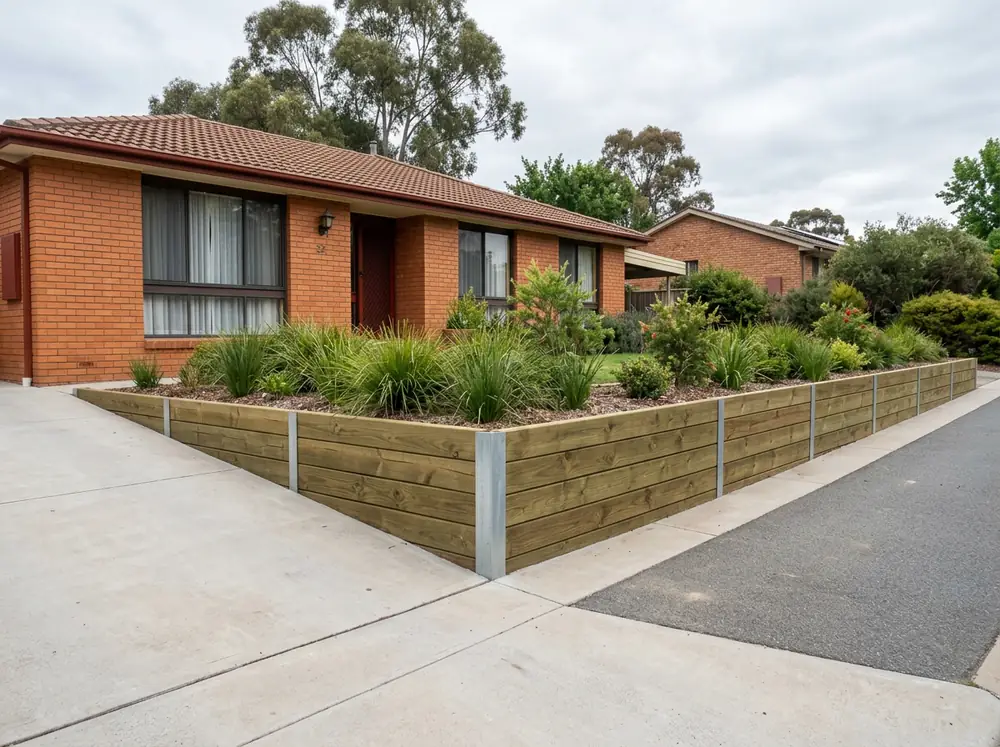

Treated Pine SleepersTreated to H4, the rating for timber that sits in the ground, so it resists rot and termites.
Hardwood SleepersNaturally dense Australian hardwood.
Treated Pine SleepersGreen-brown when new, weathering to silver-grey.
Hardwood SleepersRed-brown when new, greying with age.
Treated Pine SleepersThe lighter of the two, easy to carry in by hand.
Hardwood SleepersHeavier and denser.
Treated Pine SleepersThe cheaper sleeper.
Hardwood SleepersCosts more.
Treated Pine SleepersSold in Canberra as 200 mm high sleepers.
Hardwood SleepersLocal supply comes and goes, so we check stock before quoting.
Treated Pine SleepersH4 suits garden and landscaping walls. Where the wall is structural, such as one holding a driveway, we use H5 treated pine.
Hardwood SleepersA hardwood that is graded for strength and resists rot without treatment also suits a structural wall.
Timber retaining walls are not all one colour. These are the sleepers we build with in Canberra, bought through Pinus Sawmills and Wholesale Sleeper Co. Hardwood stock changes, so we confirm what is available when we quote.
Treated PineThe standard H4 treated pine sleeper. It starts pale green and weathers to silver-grey.
 Treated Pine
Pine coloured brown right through the timber, not just on the surface, and treated with a preservative that has no arsenic in it.
 Native Pine
A native Australian pine, pale cream with dark knots through it.
 Hardwood
A dense Australian hardwood, light brown to brown, with a rough sawn face.
 Hardwood
Red gum ranges from light pink to deep red. Other suitable Australian hardwoods can be used too.
Sleepers are all 200 mm high. The thickness changes what they can hold, and it sets the post they sit in.
Used ForGarden edging and beds one or two sleepers high. Too thin for a wall holding back soil.
Pairs WithShort pegs or a light edging post.
Used ForMost garden retaining walls and raised beds up to around a metre.
Pairs WithA 100 mm galvanised steel H post.
Used ForTaller or longer walls, and walls with more weight behind them.
Pairs WithA 150 mm galvanised steel H post.
Sleepers come in 1.8, 2.4 and 3.0 m lengths, and the length sets the post spacing. Post sizes follow the suppliers' standard sleeper-to-post guide. Between 1 m and 1.5 m, whether the wall needs an engineer is confirmed on the quote, and past 1.5 m it always does.
The drainage behind the sleepers is what keeps the timber dry, and it goes in behind every wall.

Galvanised steel H posts, coated in zinc against rust, are concreted into holes dug deeper for a taller wall.
Treated sleepers, H4 for a garden wall or H5 where the wall is structural, slide between the two side plates of each H post, called flanges, in rows 200 mm high, so five rows make a metre.
A slotted drain pipe, called an ag pipe, wrapped in a filter sock, runs along the base behind the wall to an outlet.
A filter cloth, called geotextile, goes against the soil, and clean crushed rock fills the gap so water drops to the pipe instead of soaking the timber.
In an all-timber retaining wall the posts usually fail first, because they sit in wet ground. That is why we recommend steel.
Galvanised Steel PostsZinc coated steel does not rot, and termites cannot eat it.
Timber PostsTreated timber still breaks down over time where it meets wet soil.
Galvanised Steel PostsSleepers slide out of the flanges, so a tired wall can be re-sleepered on the same posts.
Timber PostsSleepers are fixed to the face of the post, so replacing them usually means rebuilding.
Galvanised Steel PostsA slim grey post every 1.8 to 2.4 m.
Timber PostsAn all-timber face from end to end.
Galvanised Steel PostsCosts more up front.
Timber PostsThe cheaper way to build it.
We build on galvanised steel posts or properly specified timber posts, depending on the design. If you want the all-timber look, timber posts can still be done properly. WoodSolutions, the timber industry's guide, says timber that holds a structure up in the ground should be pine treated to H5, a stronger treatment than H4 made for wetter ground, or Class 1 hardwood, the most durable grade. Tell us when we measure up and we will price both.
WoodSolutions Technical Design Guide 41, the timber industry's guide to garden walls, expects a wall built to it to last 15 years or more in H4 treated pine, and over 25 years in pine treated to H5, the stronger treatment made for wetter ground. What happens around the timber matters too.
A steel post cannot rot at ground level, which is where most old walls fail.
Gravel and an ag pipe keep water moving away instead of sitting against the sleepers.
Cut ends are brushed with preservative, because a cut can expose wood the treatment did not reach.
Canberra clay holds water. Without drainage it stays wet against the timber all winter.
A buried timber post rots at the ground line long before the sleepers wear out.
Garden soil against the front of the sleepers keeps them damp.
Not Sure Timber Will Last On Your Block? Send a photo and rough measurements, and we will tell you whether timber suits it or concrete sleepers are the better buy.
Send Us A PhotoEvery timber retaining wall is quoted on site. These are the four that matter most on this wall.
 Timber SleeperWe do not price walls by the square metre or by the metre of length. Every wall is estimated after a site assessment, from what your site needs.
Treated pine is the cheaper sleeper. Hardwood costs more, and local supply comes and goes.

Galvanised steel posts cost more than timber posts and last far longer in the ground.

A taller wall needs thicker sleepers, bigger posts and deeper holes.

Gravel, an ag pipe and filter cloth go behind every wall, and they are part of the price.
Many older timber retaining walls in Canberra were built on timber posts with no drainage, and they are now leaning.
 Sign
SignA wall tipping forward or bulging in the middle has more soil pushing on it than it can hold, and it will not straighten itself.
 Sign
SignPush a screwdriver into a post at ground level. If it sinks in easily, the post is failing, even when the sleepers look fine.
 What We Do
The old wall comes out, new steel posts go in and new sleepers slot in with drainage behind. You can also switch to concrete sleepers on the same line.
Both walls are built the same way, on the same steel posts. What changes is the sleeper.
Concrete sleepers with a woodgrain face give the timber look without the rot.
See Our Concrete Sleeper WallsIf timber is not the right wall for your site, one of these usually is.
If yours is not here, ask when we come out.
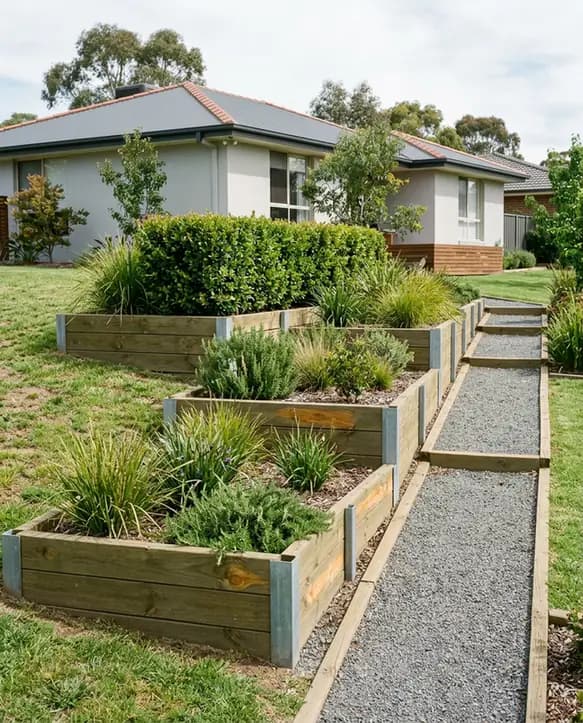
Send a photo of your site and we will tell you which wall suits it.
Send Us A PhotoEvery timber wall is estimated on its own after a site assessment, not off a square metre rate. The price moves with the height, the timber and whether the posts are steel or timber.
The WoodSolutions timber design guide expects 15 years or more from H4 treated pine and over 25 years from H5. The guide puts the longer life down to the treatment, H5 instead of H4. Steel posts and drainage behind the wall help too, because wet ground is what rots timber.
H4 treated pine suits garden and landscaping walls that are not holding up anything important. For a structural wall, such as one holding a driveway, a building or a steep slope, we use H5 treated pine or a hardwood that is graded for strength and resists rot without treatment.
H4 treated pine is made to resist rot in the ground, but it still breaks down faster when it stays wet. Drainage behind the wall and steel posts are the best protection.
The treatment protects the timber, which is why H4 pine is used in the ground. Cut ends are the weak spot, so they should be sealed with a preservative after cutting.
CCA, a copper, chrome and arsenic preservative, is still allowed in landscaping, though in 2005 the national chemicals regulator, the APVMA, stopped it for things people touch often, such as decks, garden furniture and play equipment. The Timber Preservers Association of Australia says crops like tomatoes do not take up CCA, and root vegetables can take up small amounts that peeling mostly removes. Which preservative your sleepers are treated with is confirmed on the quote, and if you would rather avoid CCA, the bed can be lined with plastic or built from pine treated with ACQ, a preservative with no arsenic in it.
To build, usually yes. Over thirty years it is often the dearest, because it gets built twice.
If the posts are steel and still straight, often yes: the old sleepers slide out and new ones go in. If the posts are timber and rotten at the ground, the wall needs rebuilding.
Yes, with an engineer's design, usually on bored pier footings, which are deep round holes drilled into the ground and filled with concrete. It stops being the cheap option at that point.
Not if it stays inside the ACT limits. Timber sleepers stack in 200 mm rows, so within 1.5 m of a side or rear boundary, or in the front yard, two rows (0.4 m) is the most you can build without a development approval from ACT Planning. Elsewhere, five rows (1.0 m) can hold back built-up soil, called fill, and six rows (1.2 m) can go in a wall cut into the slope. We measure both when we come out.

A photo and a rough length and height is usually enough for us to tell you which walls will work, before anyone drives out.
Or call (02) 5114 2500Start Here